
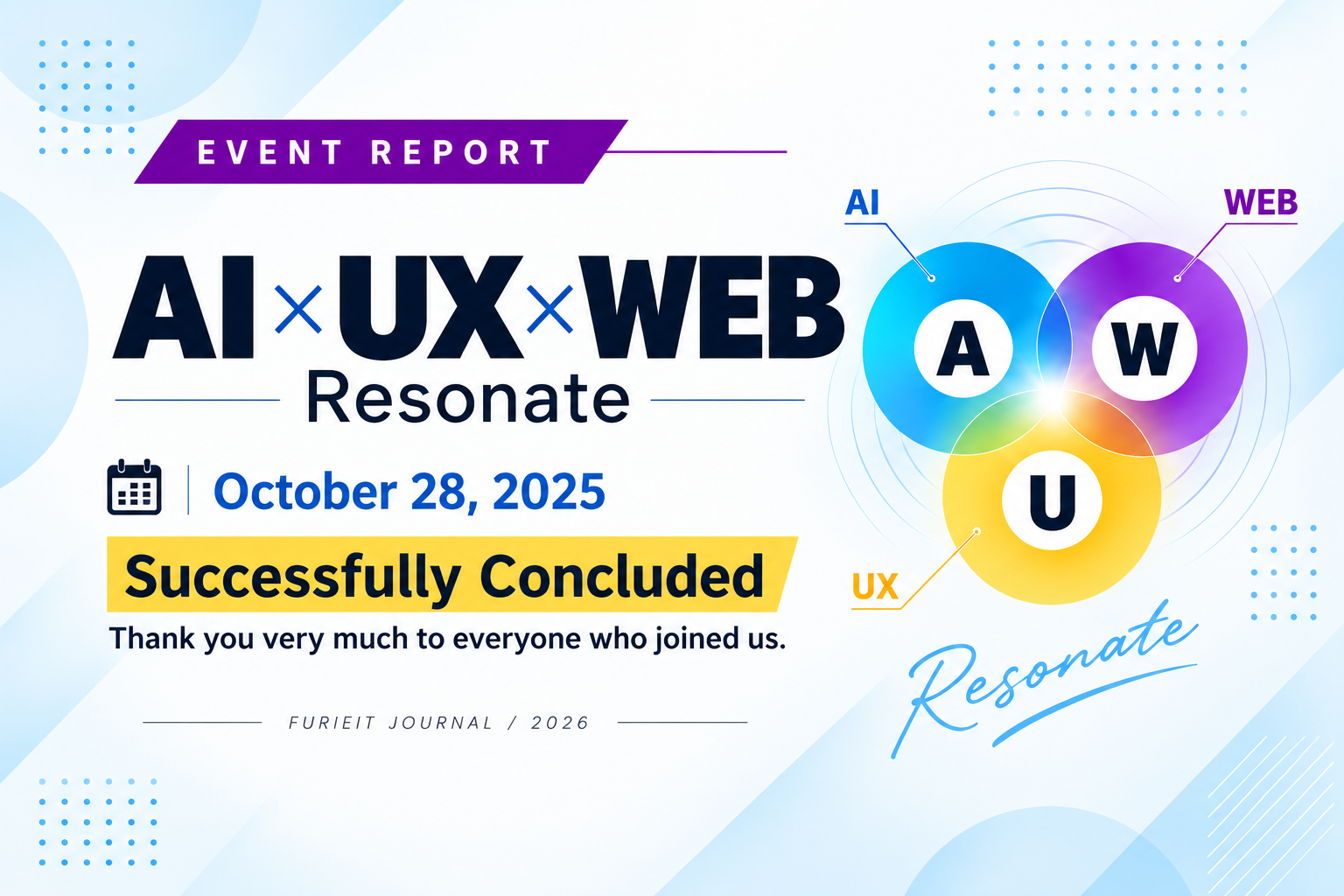
Resonate — In Conversation
AI × UX × Web
How Different Fields Are Shaping Work in the Age of AI
AI, UX, and the Web – Perspectives from Different Fields
INTRODUCTION
At the back of a coworking space is a small meeting area, almost like a semi-private room. Four people sit loosely around a large wood-grain table. A houseplant sways gently under soft lighting, and the smell of coffee hangs in the air. The atmosphere is relaxed, but focused.
Inoue
“Shall we get started? Thank you all for making the time today. It has actually been a while since we sat down like this, face to face, rather than talking on a stage.”
Hasegawa
“It really has. There is something calming about this kind of setting.”
Nagaoka
“It might actually be easier to talk here than on a stage. (laughs)”
Yamamura
“I think I can relax and speak more freely too. I am looking forward to this.”
The mood warms almost immediately. As the small talk settles, Inoue leans forward slightly and straightens his posture.
Inoue
“Let me start again properly. Today we have brought together people who work directly with AI, UX, and web production. AI has advanced rapidly over the past few years, and our work is beginning to change in major ways, for better and for worse. But how we should respond to that change is still something many of us are figuring out.”
Yamamura
“Absolutely. I feel the same way from the technology side.”
Inoue
“I would like this conversation to be a chance for small web creators, freelancers, and business owners in particular to think together about how we work and how we shape the future. Web production is not just a set of tasks. It is work that creates a flow – connecting people with people, and work with the future. So how do we create that flow and keep it moving? Let us explore it through three perspectives: AI, UX, and the web.”
They open their notebooks, and the main conversation begins quietly.
The AI Problems We Keep Seeing in WordPress Projects
NAGAOKA / 長岡祐樹
Beside the laptop on the table, Nagaoka straightens slightly before speaking.
Inoue
“Let us start with what is happening in the field with AI and WordPress. Nagaoka, have you been getting more of these kinds of questions lately?”
Nagaoka
“A lot more. Really, a lot. (laughs) The most common pattern is, ‘I asked AI, but it still did not work.’”
Hasegawa
“Ah, I can already imagine how that goes. (laughs)”
Nagaoka
“Exactly. One of the most common questions is, ‘I want to remove the sidebar.’ They ask AI, and it tells them things like, ‘Override the CSS’ or ‘Add this line to functions.php.’ They try it, and for a moment it looks fixed. Then the next day I get a message saying, ‘Another page broke,’ or ‘It came back after an update.’”
Inoue
“That is such a classic field problem.”
Yamamura
“The thing is, AI is often saying something technically correct. But…”
Nagaoka
“Right. That is the problem. AI can be ‘correct’ while completely missing the context of the actual environment.”
For example, AI may not know basic assumptions such as:
- Which theme is being used
- Whether the page is a static page or a post
- Whether the setting already exists in the admin panel
- How the child theme is structured
Nagaoka
“The person asking the question has not given AI those assumptions.”
Hasegawa
“So it is an insufficient-context prompt problem.”
Nagaoka
“Exactly. In the end, all I did was uncheck one option in the admin panel. It was a very simple fix. AI was not necessarily wrong. The question was incomplete.”
Inoue
“So AI can say something correct, and yet it still is not the right answer in the field.”
Nagaoka
“That is right. AI tries to produce the shortest route without understanding the structure, so what looks like a shortcut can become a detour. But if we understand the environment and the structure ourselves, AI can become an incredibly reliable partner.”
Yamamura
“That is actually very fundamental to how AI works. If the assumptions are right, its answers become much more stable.”
Nagaoka
“AI can make the thinking process dramatically faster. But the quality of the judgment still depends on our own understanding. That is why I always say: learn WordPress before you ask AI.”
Inoue
“That sounds like the honest view from the field. AI is not a substitute for knowledge.”
With Nagaoka’s point, the conversation gradually shifts from how to use AI to how people should relate to it.
Using AI Through the Act of Translation
HASEGAWA / 長谷川遼
As Nagaoka finishes, the group naturally turns toward Hasegawa. He closes the notes in front of him and begins with a smile.
Inoue
“Next, I would like to hear from Hasegawa, who is very much on the front line of AI implementation. What have you actually seen as you bring AI into real work?”
Hasegawa
“Sure. Let me start with a question. How many of you are paying for tools like ChatGPT or Claude?”
A few hands go up around the table. Everyone looks at one another, and a small laugh breaks out.
Hasegawa
“Exactly. Not that many. (laughs) So I think what we are about to discuss is especially relevant to people in that situation.”
Nagaoka
“I started out on the free tier too, just to see how it went. (laughs)”
Why Learning How to Write Prompts Is Not Enough
Hasegawa
“You hear it all the time now: ‘I learned how to write prompts,’ or ‘I started using AI at work.’ But the reaction I hear most often in the field is, ‘I tried it, but somehow it is not quite right.’”
Yamamura
“I know exactly what that ‘somehow not quite right’ feeling is. (laughs)”
Hasegawa
“Right. The problem is not simply how to use AI. The deeper issue is that, before giving AI information, people have not yet put their own purpose into words. You can tell AI, ‘Make me a proposal,’ but AI does not know what you actually intend.”
First, Translate the Vague Feeling Inside You
Hasegawa
“People are not very good at thinking from absolute zero. So I first ask AI to give me ten possible approaches that someone in a certain situation might use. Then I look at the list and choose the one that feels closest. Instead of ‘thinking from scratch,’ I am ‘choosing.’ And in that moment, my own values and direction start to come into view.”
Inoue
“So by choosing, you begin to see yourself more clearly.”
Hasegawa
“Exactly. AI is not just something that gives you answers. It can be something that lays out options in front of you. Once you understand that, the distance between you and AI suddenly becomes much smaller.”
Entrepreneurs Make Decisions Beyond the Statistical Norm
Hasegawa straightens slightly, choosing his words with care.
Hasegawa
“There is one more thing I often say to entrepreneurs and freelancers. AI tends to return statistically sound answers. But if the ‘average correct answer’ were always the right one, none of you would have become entrepreneurs in the first place.”
Yamamura
“True. Entrepreneurs do not exactly move according to the statistical average.”
Hasegawa
“Exactly. Entrepreneurs are people who choose beyond the statistical norm. That is why there is a gap between what AI considers correct and what feels right to you. Bridging that gap is what I mean by ‘translation.’ Before using AI, you have to translate questions like, ‘What do I really want to do?’ and ‘Which option feels most like me?’ People who can do that can use AI in a way that truly resonates with them.”
Inoue
“Translating between ‘AI’s correctness’ and ‘human individuality’ fits today’s theme perfectly.”
Hasegawa
“Yes. AI is not the enemy. It can be a partner in thinking.”
What Is Actually Happening Inside AI
YAMAMURA / 山村沙南
When Hasegawa finishes, attention naturally shifts to Yamamura. With a calm smile, she gently closes the notebook in front of her.
Think of AI as a Very Smart New Hire
Yamamura
“I would like to talk about what is actually happening inside AI, but I will try to explain it as gently as possible.”
Yamamura
“The first thing to remember is that, no matter how intelligent AI seems, it knows absolutely nothing about the background of your work.”
- What kind of clients you work with
- What stage the project is in
- What constraints you are working under
Yamamura
“It knows none of that. So when I explain AI to people, I always say this: treat AI like an extremely smart new hire.”
Hasegawa
“Ah, that makes the idea instantly clear. (laughs)”
Nagaoka
“I know exactly what you mean. (laughs)”
Yamamura
“Right? A new hire does not know what they have not been told. But if you explain things, they can absorb them quickly. AI is similar. That is why it is so important to communicate carefully, on the assumption that AI does not know the background.”
When We Say “AI Learned,” That Is Not the Same as Actual Learning
From here, Yamamura moves a little deeper into the technical side.
Yamamura
“You often see phrases like, ‘AI learned this’ or ‘AI remembers this.’ But technically speaking, that is not the same thing as learning.”
Inoue
“Really?”
Yamamura
“Actual learning means updating the AI itself – in other words, changing the model weights. That requires enormous computing resources and does not normally happen in an ordinary chat environment. What looks like ‘learning’ to us is the system searching prior context, combining it, and producing a plausible inference.”
Hasegawa
“I do not think many people realize that.”
The Longer the Conversation, the More AI “Gets Tired”
Yamamura
“There is one more thing I want people to remember. AI has a ‘context length’ – a limit to how much text it can keep in view. OpenAI, Anthropic, Google – everyone is competing to say, ‘We can handle longer contexts.’ But in practice, computational cost increases with the square of the amount of text, so the longer the conversation becomes, the more strain the system is under. In other words, the longer you keep talking, the more accuracy can fall.”
Nagaoka
“So it is like a new hire who gets tired if you keep talking for too long. (laughs)”
Yamamura
“Exactly. (laughs)”
Let AI Take Notes, and Break the Conversation into Sections
Yamamura
“So one way to keep performance stable is to divide threads at appropriate points and summarize the key ideas before carrying them into the next conversation. You can simply ask, ‘Summarize the key points so far in three lines,’ then paste that summary into the next conversation. AI becomes much more stable.”
Hasegawa
“So you are asking AI to organize the information itself.”
Yamamura
“Yes. It is like having a new hire keep notes.”
- Take notes
- Have a human review them
- Correct anything that is wrong
Yamamura
“That repeated cycle is how you build a kind of ‘trust’ with AI.”
Inoue
“It is almost like developing AI as a teammate. That makes the idea very clear.”
Yamamura
“Yes. AI cannot read the room the way a person can. But if you communicate properly, it will respond. So when you work with AI, pay attention to how you communicate. That is the one thing I most wanted to convey today.”
A small sense of relief settles over the table.
The Meaning UX Creates – and the Philosophy Behind It
INOUE / 井上龍登志
As Yamamura finishes, the atmosphere around the table softens again. Inoue turns the pen in his hand once, then begins to speak slowly.
UX Is a Design Philosophy for Moving Experience
Inoue
“Let me finish with a few thoughts on UX. I do not mean this as some grand theory. I am speaking as another creator working in the same field as everyone here.”
Inoue
“UX is often understood as an extension of UI, or simply as a design issue – making a screen look better, or preventing users from getting lost. But that is not the essence of it. UX is a way of designing the flow of an experience: what a person feels the moment they encounter a service, and how that feeling moves them to act. It includes not only ‘This is good,’ but emotional responses such as ‘I am happy’ or ‘That moved me.’ UX therefore deals not only with logical correctness, but with how something comes across and how it is felt.”
A “Correct” AI-Written Sentence Is Not the Same as One That Reaches People
Hasegawa
“You really feel that when you use AI. The writing can be clean, but the question of ‘Who is this actually for?’ often disappears.”
Inoue
“Exactly. That is where UX has work to do. AI-generated writing can be correct and easy to read, but sometimes the intended reader becomes vague. UX design is about shaping that flow so a person’s feelings can move smoothly through the experience.”
Nagaoka
“I really get that. It can be technically correct but somehow lose the reader’s emotional temperature.”
Inoue smiles lightly and nods.
At the Core of UX Is Philosophy
Inoue
“And if we go one level deeper into UX, there is always a philosophy behind it.”
Yamamura
“A way of thinking – a philosophy.”
Inoue
“Exactly. In UX, questions like ‘What matters to us?’ and ‘What value do we want to deliver?’ become the axis of the design. There are many things in the world that look like UX on the surface but have no real meaning underneath. Without a philosophy, even something beautifully organized may never reach people emotionally.”
He speaks quietly, but with conviction.
FURIEIT’s UX Is Designed to Keep the Flow Moving
Inoue
“At FURIEIT, system-building is part of our UX work, but the system itself is not the goal. A system is only a means. What we really want to create is flow.”
- A flow that keeps creators from getting lost
- A flow that helps clients think more clearly
- A flow that moves people emotionally and moves services forward
Inoue
“We design UX templates and interview sheets so that these kinds of flow do not stop.”
Hasegawa
“That really makes sense to me – especially the idea that the system itself is not the purpose.”
Inoue
“Exactly. AI creates speed. UX gives meaning. Web implementation puts that meaning into motion in the world. When those three resonate, work can finally keep moving instead of getting stuck. That is the kind of UX we care about.”
A quiet pause remains over the table, as if what lingered was not just the words, but the philosophy behind them.
What Do We Mean by “Resonance”?
CLOSING
The conversation settles for a moment. Between the four of them comes the quiet that follows when something important has been said. Inoue takes a breath and begins to bring the discussion together.
When AI, UX, and the Web Intersect, Flow Emerges
Inoue
“Let me finish by sharing what I felt through today’s conversation. AI creates speed. UX creates meaning. The web creates movement. When those three remain separate, work tends to stop somewhere along the way. But when they begin to resonate with one another, as they have in today’s discussion, we can create a system in which work keeps moving and the flow continues.”
Nagaoka
“That really matches what we see in the field.”
Resonance Happens When Different Perspectives Connect
Inoue
“The four people at this table actually come from very different fields and positions.”
- WordPress implementation in the field – Nagaoka
- Front-line AI implementation – Hasegawa
- Inside AI development – Yamamura
- UX and system design – Inoue
Inoue
“At first glance, those fields can look unrelated. But I believe resonance happens at the moment different perspectives connect. Resonance is what happens when different viewpoints begin to echo one another and create a single flow. That is what I felt most strongly today.”
Hasegawa
“Yes. I really felt that today too.”
Systems Are Not the Goal – They Are a Way to Protect the Flow
Inoue leans forward slightly, placing each word carefully.
Inoue
“There is one last thing that matters deeply to us at FURIEIT. Systems are not the goal. They are a way to protect the flow. AI brings speed. UX gives meaning. The web carries it into the world. We design UX and build systems so that this flow can keep moving without stopping.”
Yamamura
“So AI and people each have their own role within the same flow.”
Inoue
“Exactly. There are things only AI can do, things only people can do, and things UX needs to organize. Each has its own role, but when they come together as one resonant flow, I think that is what the future of web production should look like.”
Closing Words
No longer speaking simply as the moderator, but as one of the group, Inoue offers the final words.
Inoue
“Thank you. Hearing the real experiences each of you shared today has given me a lot of courage as well.”
The four naturally smile. Chairs slide back quietly, and the afternoon light of the coworking space falls across the table.
Japanese
https://furieit.com/event-report-ai-ux-web/
— FURIEIT JOURNAL —
Credits
Event Supervisor
Masaki Yamada | Principal Patent Attorney, Masaki Yamada Patent Office
Participants
Hiroki Nagaoka | Representative, WordPress 110
Ryo Hasegawa | Representative Director, Eccentric Inc.
Sanami Yamamura | Representative Director, Synome Inc.
Tatsutoshi Inoue | Representative Director, FURIEIT Co.,Ltd.
Editorial Note
This article was shaped into a conversational feature after the event, based on discussions that took place at an event held in 2025. All participants reviewed the article before publication.