
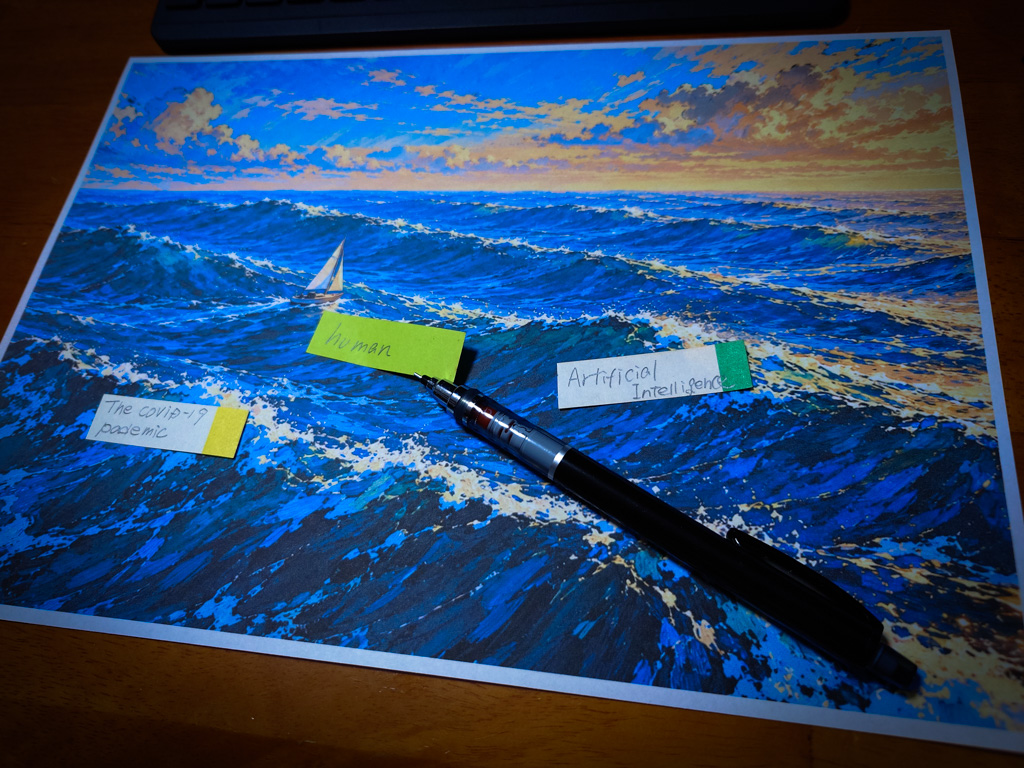
コロナ禍とAI。
一方は世界を襲った感染症であり、もう一方は人間が生み出した技術です。
当然ながら、この二つを同じものとして語ることはできません。
けれど、社会に与えている影響を少し引いて眺めてみると、不思議と似た「波の形」が見えてきます。
どちらも短期間のうちに世界規模へ広がりました。
そして、一度の大きな変化で終わったわけではありません。
コロナ禍では、次々と新しい変異株が現れ、そのたびに社会は新しい対応を迫られました。
最初は誰も正解を知りませんでした。
人との距離をどう取るのか。
仕事をどう続けるのか。
学校をどうするのか。
店をどう開けるのか。
社会は混乱しながら、それでも踏ん張りました。
マスク、換気、オンライン会議、リモートワーク、オンライン授業、EC。
次の波が来るたび、前の波で得た経験を使いながら、少しずつやり方を変えていった。
今でも、その日々を思い出すことがあります。
変化したのはウイルスだけではありません。
社会の側も、波を受けながら変化していたのだと思います。
そして今、AIでも似たことが起きています。
新しいモデルが現れる。
できることが増える。
それまで難しかったことが、突然できるようになる。
そのたびに企業は使い方を考え、学校はルールを考え、行政は制度を考え、個人もまたAIとの付き合い方を覚えていく。
AIだけが進化しているように見えて、実際には、AIを受け止める社会の側も変化し続けています。
もちろん、大きな違いがあります。
コロナの波は、人間が望んで起こしたものではありません。
AIの波は、人間自身が作り出し、さらに大きくし続けているものです。
それでも、世界規模の変化が繰り返し押し寄せ、そのたびに社会が学習し、対応を変えていく。
その現象には、どこか似たところがあります。
そして、もう一つ、気になることがあります。
コロナ禍のあとに、AIの波が来たということです。
コロナ禍以前から、インターネットもスマートフォンもPCもクラウドも存在していました。
けれど、コロナ禍によって、それらは便利な道具であるだけでなく、社会を維持するための重要な基盤として、さらに深く生活の中へ入り込みました。
家で仕事をする。
画面越しに会議をする。
ネットで買い物をする。
オンラインで学ぶ。
遠く離れた人と、画面を通じて話す。
人の身体は家の中へ退避し、社会のさまざまな活動がネットワークの上へ移りました。
その数年間で整えられた端末、ネットワーク、クラウド。
そして何より、オンラインと共に暮らすことへの慣れ。
その社会へ、生成AIがやってきました。
現在、多くの人が生成AIを使うために必要なのは、特別な装置ではありません。
私たちがすでに持っているスマートフォンやPC、そしてインターネットへの接続です。
つまり、AIが社会へ入ってくるための入口は、すでに多くの人の手元にあった。
コロナ禍がAIを生んだわけではありません。
しかし、コロナ禍を乗り越えるために社会が急速に整えたデジタル環境と、その中で暮らすことへの慣れが、結果としてAIを受け入れるための土壌の一部になったのではないか。
そんなふうにも見えます。
もし、現在の生成AIがコロナ禍以前の社会に突然現れていたら、同じ速度で世界へ広がったでしょうか。
答えを確かめることはできません。
けれど、考えてみる価値はあると思います。
そして、この二つの波にはもう一つ、大きな共通点があります。
どちらも、単に技術や仕事のやり方を変えただけではありません。
人間の生き方そのものを問い直していることです。
コロナ禍では、人と会うとは何か、働く場所とは何か、離れていても人はつながれるのか、といったことを考えさせられました。
AIは今、考えるとは何か、つくるとは何か、仕事とは何か、人間が担うものは何なのかを問い始めています。
コロナ禍では、人間と人間の距離が問い直されました。
AIでは、人間と知性の距離が問い直されているのかもしれません。
私たちは、コロナ禍という大きな波を、さまざまな犠牲を払いながらも、ぎりぎりのところで踏ん張り、社会を続けました。
その経験の直後に、今度はAIという別の波が来ています。
AIを受け入れるための準備は、ある程度整っていた。
では、
AIと共に生きるための準備は、私たちにはもう整っているのでしょうか。
English
COVID-19 and AI.
One was a global pandemic.
The other is a technology created by humans.
Of course, the two cannot be treated as the same thing.
And yet, when we step back and look at the impact they have had on society, a strangely similar shape of the wave begins to emerge.
Both spread across the world in a remarkably short period of time.
And neither came as a single, one-time disruption.
During the COVID-19 pandemic, one new variant after another appeared, and each time, society was forced to respond again.
At first, no one knew the right answer.
How much distance should we keep from one another?
How could we keep working?
What should schools do?
How could businesses stay open?
Society was confused, but somehow, it held on.
Masks. Ventilation. Online meetings. Remote work. Online classes. E-commerce.
Each time another wave arrived, we drew on what we had learned from the one before and gradually adjusted the way we lived and worked.
Even now, I sometimes find myself remembering those days.
It was not only the virus that was changing.
Society itself was changing as it learned to live through each wave.
And now, something similar is happening with AI.
A new model appears.
Its capabilities expand.
Something that seemed difficult suddenly becomes possible.
Each time, companies reconsider how to use it. Schools reconsider their rules. Governments reconsider their policies. And individuals learn, little by little, how to live and work with AI.
It may look as though AI alone is evolving.
But in reality, the society receiving it is changing as well.
Of course, there is one fundamental difference.
The waves of COVID-19 were not something humanity chose to create.
The waves of AI are being created by humans themselves—and we continue to make them larger.
Still, in both cases, change spreads across the world in successive waves, and society learns, adapts, and changes its response each time.
There is something strangely similar about that pattern.
And there is one more thing that interests me.
AI arrived after the pandemic.
The internet, smartphones, PCs, and cloud computing all existed long before COVID-19.
But during the pandemic, they became more than convenient tools. They moved deeper into everyday life as essential infrastructure for keeping society functioning.
We worked from home.
We held meetings through screens.
We shopped online.
We studied online.
We spoke face-to-face with people far away, through a display.
Our bodies retreated indoors, while many of society’s activities moved onto networks.
Over those few years, devices, networks, and cloud infrastructure became more deeply embedded in daily life.
And perhaps more importantly, we developed something else:
the habit of living alongside the online world.
Then generative AI arrived.
Today, most people do not need any special equipment to use generative AI.
They need the smartphones and PCs they already own—and a connection to the internet.
In other words, the entrance through which AI could enter society was already sitting in the hands of millions of people.
The pandemic did not create AI.
But perhaps the digital environment that society rapidly built in order to survive the pandemic—and our growing familiarity with living inside that environment—became part of the soil in which AI could spread so quickly.
It is an interesting question:
If today’s generative AI had suddenly appeared in the world before the pandemic, would it have spread at the same speed?
We cannot know the answer.
But I think it is worth asking.
And there is one more major similarity between these two waves.
Neither has merely changed our technology or the way we work.
Both have forced us to reconsider how human beings live.
During the pandemic, we were made to think about what it means to meet another person, what a workplace really is, and whether people can remain connected even when they are physically apart.
AI is now asking a different set of questions.
What does it mean to think?
What does it mean to create?
What is work?
And what, ultimately, should remain the role of human beings?
The pandemic forced us to reconsider the distance between human beings.
AI may be forcing us to reconsider the distance between human beings and intelligence.
We lived through the enormous wave of the pandemic.
It brought countless losses and tragedies, yet society somehow held together and kept moving.
And almost immediately afterward, another wave arrived.
This time, it was AI.
To some extent, the conditions for accepting AI were already in place.
So the question now is:
Are we also ready to live alongside AI?